

The Promise Fulfilled
How Proposition-Level Legal Knowledge Representation at Corpus Scale Realizes Three Decades of Computational Jurisprudence

For thirty-five years, the computational jurisprudence tradition has specified what genuine legal reasoning requires: adversarial directionality (Ashley, 1990), typed rule systems (Prakken and Sartor, 1996), and structured precedential constraint (Horty, 2024a). These requirements were never refined away by subsequent scholarship. They were confirmed and formalized. Yet the dominant architecture in deployed legal AI, retrieval-augmented generation over document-level indices, satisfies none of them, and the commercial editorial tradition of headnotes and citators, the closest existing artifacts, stops short on every axis. This article argues that the resulting gap is not an incremental limitation but a categorical one, and that it is now closeable. We develop a taxonomy of five structural failure categories in document-level legal AI: authority-health blindness, jurisdictional conflation, doctrinal boundary collapse, directional opacity, and negative-space ignorance. Each category maps to a representational requirement that the AI and Law tradition identified from first principles. We introduce the distinction between structural reliability, where the stored representation makes an error class impossible or reliably detectable, and opportunistic reliability, where correctness depends on whether retrieval happens to surface missing context. We demonstrate that agentic augmentation converts some failure categories from systematic to opportunistic but leaves three categories entirely intact, because they are knowledge representation failures, not coverage failures. We then specify the minimum representation requirements for structural reliability: proposition-level extraction, typed adversarial metadata, authority-health composites, jurisdiction-hierarchy modeling, and rejected-argument indexing as first-class objects. We argue that these requirements are now achievable at full corpus scale, over 8.2 million published United States judicial opinions, through large language model-based extraction pipelines, and that the recall problem traditionally associated with corpus-scale extraction is addressable through controlled query decomposition architectures. We report validation results from a production knowledge store built to this specification, and we describe what the representation enables beyond research: a companion measurement instrument, built on the same substrate, that quantifies the openness of a contested procedural ruling as noise-corrected dispersion across posture-conditioned reasoners. The article concludes with an argument that the field should recognize this moment as the fulfillment of its founding project, not as an incremental improvement to existing tools.
- Authors
- Ross Brodskiy
- Posted
- 15 April 2026 (SSRN)
- SSRN abstract
- 6297518
- Length
- 37 pages
- DOI
- Not yet assigned
- Keywords
- legal knowledge representation, proposition-level extraction, retrieval-augmented generation, structural reliability, computational jurisprudence
- The AI and Law tradition (Ashley, Aleven, Prakken and Sartor, Horty) specified adversarial directionality, typed rules and structured precedential constraint; document-level retrieval-augmented generation satisfies none of them, and headnotes and citators stop short on every axis.
- Document-level legal AI fails in five structural ways: authority-health blindness, jurisdictional conflation, doctrinal boundary collapse, directional opacity and negative-space ignorance.
- Agentic augmentation partially mitigates authority-health blindness and jurisdictional conflation, but only opportunistically, and leaves the other three categories intact because they are knowledge representation failures, not coverage failures.
- Structural reliability requires five things: proposition-level extraction, typed adversarial metadata, authority-health composites, jurisdiction-hierarchy modeling and rejected-argument indexing.
- On a 700-case stratified sample (15,334 records across 22 dimensions), automated cross-model validation reported 99.97 percent field-level accuracy and 99.71 percent record-level precision; the paper stresses that this measures precision, not recall, and is not commensurate with end-to-end hallucination studies.
- Recall is recast as a property of query architecture: near-deterministic for constrained drafting tasks, bounded and auditable for open-ended research, and testable through bar-exam-style functional recall.
- 1. Introduction: The Longest Gap in Applied AI
- 2. What the Field Always Knew: The AI and Law Tradition
- 3. The Document-Level Detour: Five Structural Failure Categories
- 4. Why Agentic Augmentation Does Not Close the Gap
- 5. What Fulfillment Requires: The Minimum Representation Specification
- 6. Feasibility, Validation, and the Recall Architecture
- 7. Professional Responsibility: What Competence Now Requires
- 8. The Field Was Right
The paper in brief
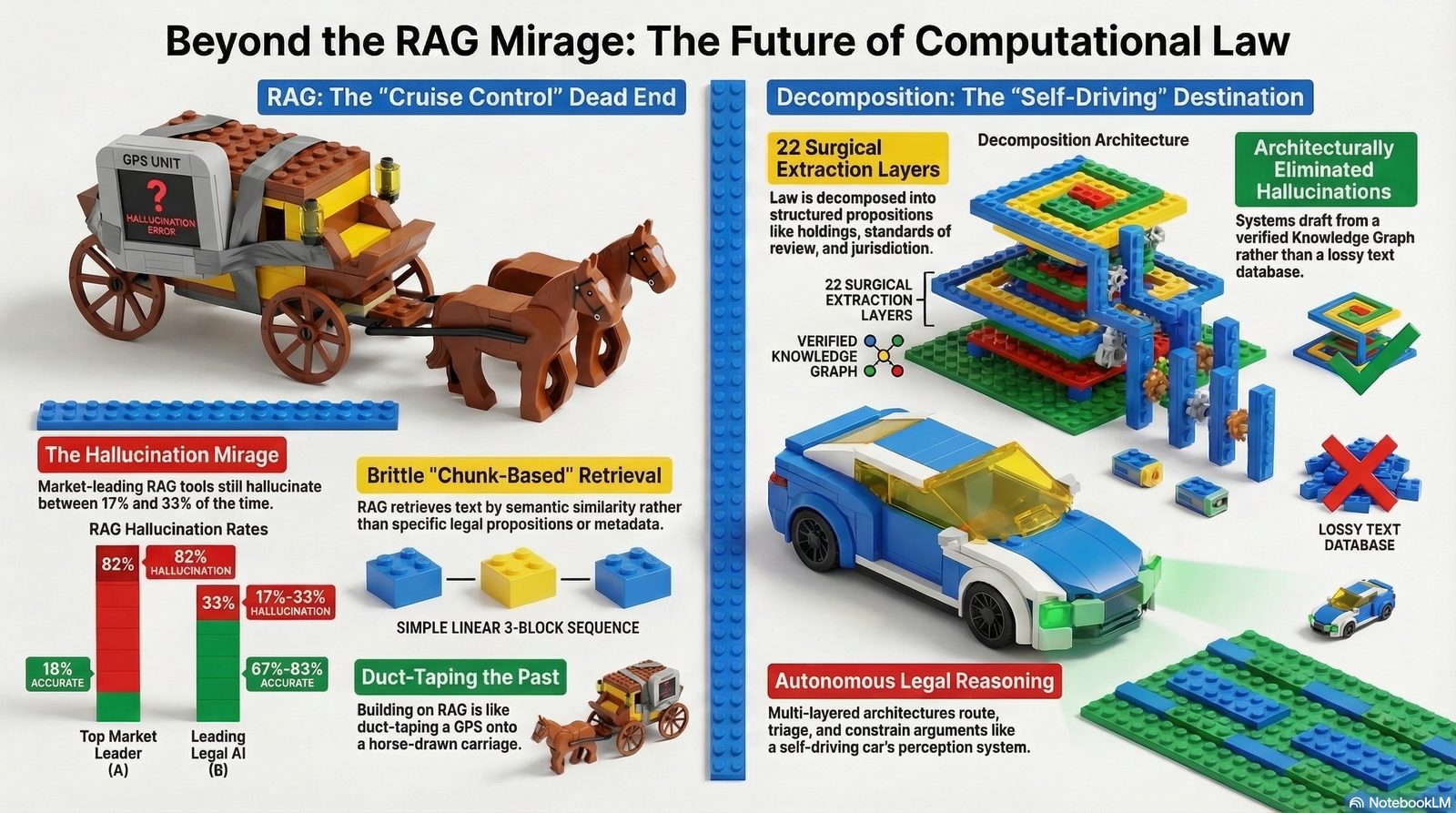
The argument in toy bricks: retrieval-augmented generation as a horse-drawn carriage fitted with a GPS unit, decomposed proposition-level reasoning as a self-driving car.
The paper's claim is historical as much as technical. Computational jurisprudence has known for thirty-five years what legal reasoning requires. Deployed legal AI detoured around that knowledge. The detour can now be ended, and the paper sets out what ending it takes. This summary follows the current revision of the manuscript; a prior version was posted to SSRN on 15 April 2026.
1. The longest gap in applied AI
The gap is neither one of capability nor of theory. It lies between specification and realization. Ashley's HYPO modeled legal argument as adversarial; Aleven's CATO tagged every factor as plaintiff-favoring or defendant-favoring; Prakken and Sartor formalized why legal rules must be typed; Horty's The Logic of Precedent treats precedent as structured constraint. The dominant deployed architecture, by contrast, retrieves text by semantic similarity and asks a language model to synthesize an answer. It is fluent and genuinely productive. It does not know which party a holding favors, which stage a standard governs, whether an authority still stands, or what courts have refused to do.
2. What the field always knew
The paper reads the AI and Law literature as an engineering specification that remains binding. Legal holdings are deontic allocations, not neutral descriptions: a rule placing a burden on the employer favors the employee. Rules are typed: Auer governs agency readings of their own regulations, Chevron governed (until Loper Bright) agency readings of statutes, and Skidmore weighs persuasiveness. A similarity index collapses all three into "deference." Horty's model presupposes extracted holdings and stored relationships; without them it is a formal system without inputs.
Why was this never built? The answer is infrastructure. The corpus runs to more than 8.2 million published opinions, and the classic systems were encoded by hand. Industry took the achievable path, which was economically rational and representationally inadequate. Large language models now supply the extraction capability that makes the original specification buildable. The paper also meets the obvious objection head-on: West headnotes and citators are the genuine commercial ancestors of this work, proving both the demand and the ceiling of manual methods. They are topical rather than typed, classify treatment at the wrong granularity, and carry a documented error profile.
3. Five structural failure categories
Each category maps to a requirement the tradition identified, and each is shown with verified primary authority.
- Authority-health blindness. A system without an authority field serves Chevron as live law. The subtler case is Kisor v. Wilkie, which kept Auer deference but added prerequisites that made it, in practice, challenger-favorable. A citator reports Kisor as good law, accurately and uselessly.
- Jurisdictional conflation. Celotex and California's Aguilar standard are co-retrieved for any query on the movant's initial burden, and a blended answer is neither federal nor California law. California's Yamaha framework shows that the applicable deference regime can turn on the kind of agency act involved.
- Doctrinal boundary collapse. Similar vocabulary merges distinct doctrines into a spectrum, and holdings blur into dicta.
- Directional opacity. No publicly described commercial system stores which party a holding favors.
- Negative-space ignorance. No commercial system indexes rejected arguments as first-class objects, so document retrieval "forgets the no."
4. Why agentic augmentation does not close the gap
This is the analytical core. A coverage failure means the needed information exists somewhere and was not retrieved; a knowledge representation failure means it is not a property of any document at all. Agentic search fixes the first kind, opportunistically: it will find Loper Bright because the overruling is salient. It cannot produce a directional tag, a typed boundary or an index of rejections at query time. The paper concedes that a well-resourced agent could classify on the fly, then argues that query-time classifications are ephemeral and unauditable, while ingestion-time records are persistent, versioned and measurable. Run-to-run variance becomes the diagnostic: structural reliability is deterministic; opportunistic reliability is stochastic.
5. The minimum representation specification
Five requirements follow, each derived from a failure category: proposition-level extraction linked to source text; typed adversarial metadata implemented as enforceable filters rather than labels; authority-health composites at the proposition level; a formal model of binding-authority relationships, which the paper identifies as an open problem; and rejected-argument indexing performed at ingestion. Graph-based retrieval is discussed and set aside, because edges derived from co-occurrence are not typed legal classifications.
6. Feasibility, validation and recall
The authors report building a proposition-level store from the CourtListener corpus and validating a stratified sample of 700 high-impact cases from New York, California and Delaware. Three frontier models scored each record against the source opinion, yielding 99.97 percent field-level accuracy and 99.71 percent record-level precision, with rejected-argument indexing, gray-area detection and overruled detection accounting for most remaining errors. The paper is explicit about limits: this measures precision, not recall; automated cross-model review substitutes imperfectly for expert annotation; the sample oversamples high-citation cases. It then argues that recall should be treated as a property of query architecture. Constrained drafting tasks route a single predicate to a typed index and approach determinism. Open-ended research introduces bounded, inspectable variance in the decomposition step. Functional recall can be tested the way bar examiners test issue-spotting.
The revision adds a section on what the substrate enables: a companion instrument that measures the openness of a contested procedural ruling as noise-corrected dispersion across posture-conditioned reasoners. A logged smoke test on an engineered motion produced a dispersion well above its own noise floor, which the paper presents as a demonstration of mechanics, not of empirical validity.
7. Professional responsibility
Model Rule 1.1, Comment 8, and ABA Formal Opinion 512 frame competence around verification. The taxonomy sharpens what verification must cover: authority health, jurisdiction, direction and negative authority. The paper proposes that tools disclose which failure categories their representation structurally covers, and notes that the EU AI Act classifies AI that assists judicial authorities in researching and applying the law as high-risk.
8. The field was right
The tradition specified the requirements; industry built without them and improved a metric that does not capture them. A system can hallucinate zero citations and still serve dead law. The infrastructure to meet the specification now exists, and the paper closes with a plain instruction: it is time to build.
The paper discloses that its authors are affiliated with the company that develops the knowledge systems described in its validation and measurement sections.
Where to go next
- Why Retrieval Is Not Reasoning: the case against document-level RAG, retold for builders.
- Good Law for What?: the same failure categories turned into a verification protocol for librarians.
- Posture-Dispersion Z: the measurement instrument the substrate makes possible.
- The Long Road to Applied Computational Law: the intellectual history behind "the field was right."
Terms in this piece
Revision history
| 1 Sep 2026 | Paper page created. |
How to cite
Brodskiy, R. (2026, April 15). The Promise Fulfilled: How Proposition-Level Legal Knowledge Representation at Corpus Scale Realizes Three Decades of Computational Jurisprudence [Working paper]. SSRN. https://papers.ssrn.com/sol3/papers.cfm?abstract_id=6297518
Related pieces



New papers, frameworks and essays. No marketing. Or use RSS.