

The Thread in the Courtroom
Some Cases Have One Path and Some Have Many. What Would It Mean to Measure the Difference?
At 11:40 on a Tuesday night, a litigator named Mara Ellison sat in a conference room on the nineteenth floor with the lights off except for one lamp. The motion to dismiss would be heard at 9:30. Her brief was filed. Her outline was printed, tabbed, and printed again. A container of noodles had gone cold beside the binder an hour ago.
Mara is invented. I made her up for this essay, and her case with her. But I suspect you have met her.
Her client was a buyer. It had paid a great deal of money for a business line on the strength of what it was told: that the business had a certain number of active customer contracts, a certain stream of recurring revenue, and a software platform that worked. After closing, the contracts turned out to be fewer, the revenue smaller, and the platform something closer to a prototype. The contract claim was not really in dispute. The fraud claim, bolted alongside it, was the whole fight, and the other side had moved to dismiss it.
Mara knew the law. That was not the problem. She knew the cases that said a sophisticated buyer who signs a fully integrated agreement has no business crying fraud about promises it chose not to write down. She knew the cases that said, at the pleading stage, you take the plaintiff's account as true and leave the facts to discovery. Both lines were real. Both were good law. Neither was a stretch.
What she did not know was the judge.
She had read every order the judge had signed on a motion like this one that she could find. Some let fraud claims through. Some did not. She had tried to find the pattern and found only her own hope reflected back at her. At 11:15 the client's general counsel had emailed a single line: What are our odds tomorrow? She had written three answers and deleted all three.
Anyone who has carried a motion into a courtroom knows a night like this. The research is done. The argument is sharp. And underneath it all sits a question no brief can answer: does this case have one way out, or several, and which door will the person on the bench choose?
One path, or many
Ross Brodskiy and Nathan Pokov open their paper, Ariadne's Thread, with a story much smaller than Mara's. A child complains: My sister got two cookies and I got one. That is the whole complaint.
Hand that dispute to any judge you like, strict or lenient, hurried or patient, and they will reach the same place. Equal shares; give the child a cookie. Different judges might take different routes there, faster or slower, with more or less talk of proof. But they arrive together. The case has one path.
Now add a single clause. My sister got two cookies and I got one, but she did the dishes.
Suddenly the room divides. A judge who cares most about equal shares still gives the child the cookie. A judge who believes that work earns reward says the sister earned it. A skeptical judge asks whether anyone actually saw the dishes get done, and dismisses the complaint for want of proof. Nothing in the law got more complicated. What arrived was a conflict of values that lawful, sensible people resolve differently. The case now has many paths.
The authors are careful to call this an intuition pump, not evidence. But it names the thing Mara was feeling at 11:40. Some cases are decided by the law, and it hardly matters who hears them. Some cases are decided by the judge, and the law, honestly read, permits either result. Lawyers sense the difference constantly. They price it into settlements and argue about it in hallways. What they rarely do is measure it.
The judge who decides, and the one who guides
For half a century, legal philosophy has argued about whether every hard case has one right answer. Ronald Dworkin imagined a judge named Hercules, so patient and so wise that he could read the entire body of law as one coherent whole and find the single correct answer even in the hardest case. H.L.A. Hart, and the positivists who followed him, thought that at the edges of every rule there is a zone where the law runs out and the judge must choose.
It is tempting, now that machines can write fluent legal prose, to try to build Hercules. Brodskiy and Pokov decline. A machine that decides cases would carry every objection we have to automated judgment, and rightly so. Worse, Hercules assumes the very thing in dispute, that the single right answer is always there to be found.
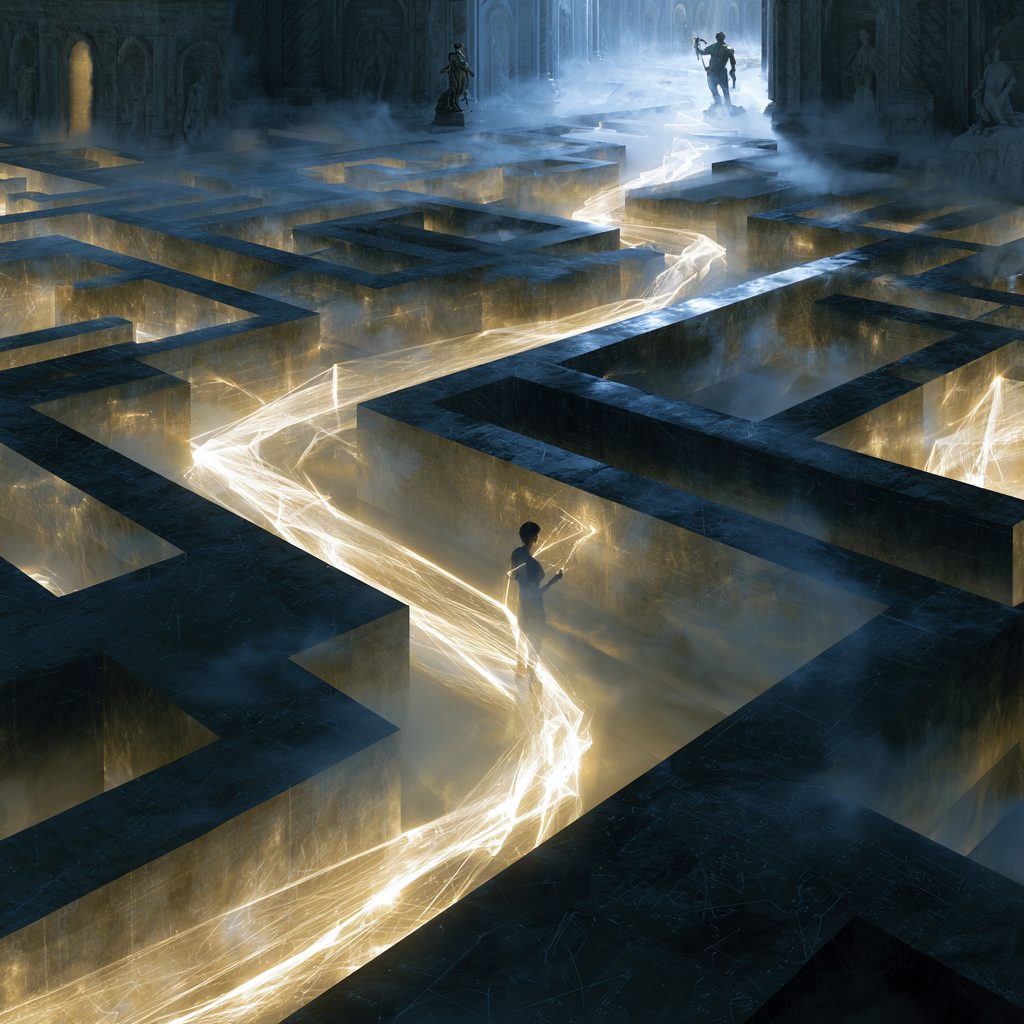
So they reach for a different figure. In the old story, Ariadne does not fight the Minotaur. She does not walk the labyrinth for Theseus. She hands him a thread so that he can find his way. In the paper, the dispute is the labyrinth, the lawful ways a judge might approach it are the corridors, and a number the authors call Z is the thread. It does not tell you who wins. It tells you whether the maze has one path or many.
A room full of judges
Here is how the measurement works, in plain terms.
Imagine a panel of judges. Not real ones: simulated judges, each given a different but lawful temperament. One likes to end weak cases early, at the pleading stage. Another prefers to let a case develop and decide it later, once the record is built. One is generous with discovery; another keeps it on a short leash. The paper calls each of these temperaments a posture, and it is careful to separate posture from politics. A posture describes how a judge runs cases, never whom the judge favors.
Every simulated judge receives exactly the same case. And, crucially, every one reads from exactly the same stack of law: verified, current, the same authorities in the same form. The authors treat this as the precondition for everything else. If one judge were working from a case that had been overruled and another from a case that did not exist, their disagreement would tell you nothing about the law. It would only tell you that someone had handed them different books.
At each decision point in the case, which the paper calls a gate, every judge gives a single score from 1 to 10, like a figure-skating judge holding up a card. A 1 means the claim sails through. A 10 means it is almost certainly thrown out. Each score comes with a one-line reason.
If the cards all say roughly the same thing, the case has one path. If they scatter, the case has many.
Measuring the wobble
There is a subtlety here that I find quietly moving, because it is a lesson about honesty.
Any instrument wobbles. Ask the same simulated judge the same question twice and it will not always answer identically. So before trusting the scatter among different judges, the authors measure the scatter within a single judge asked the same thing again and again. That inner wobble is the instrument's noise floor, and the method subtracts it before reading anything from the rest.
And if what remains is no larger than the wobble itself, the instrument says nothing at all. It abstains. It does not dress up noise as insight. In a profession where silence is often read as weakness, there is something bracing about a tool built to know when it does not know.
The invented case, tested
Mara's case is invented. So, as it happens, is the case the authors used to test their pipeline: a fictional New York commercial dispute in which a sophisticated private equity buyer paid forty-two million dollars for a business line that turned out to be much smaller than represented, with a fraud claim riding alongside an uncontested contract claim. They built it deliberately on a knife edge, so that a strict judge could dismiss the fraud claim and a lenient judge could sustain it, and neither would be misreading anything.
Five simulated judges, one pleading gate, the same stack of law for all of them. Three denied the motion. Two granted it. The scores ran from 2 to 8.
One judge stayed with me. It was set to be among the most aggressive at ending cases, but to prefer ending them late. It let the claim through, and wrote a warning into its opinion: the fraud claim should expect a hard look at summary judgment. That is a recognizable human judge, and it could only appear because the temperament had more than one dial.
The authors also ran a middle-of-the-road judge three times, and then three more times after telling it that it was an irritable morning before coffee. The mood moved its score by about a point. It never changed the ruling. The gap between the judges was not the machine rolling dice.
And every judge, asked to mark the place where its answer was a choice rather than a command of the law, pointed to the same place: whether a sophisticated buyer's claim of having been deceived is a question for trial or something a court may decide on the papers. Each conceded that a judge who went the other way would not be wrong.
The authors are scrupulous about what this shows. It was one engineered case, one gate, one underlying model, a hand-built stand-in for the full legal library. It proves that the machinery runs and that, this once, the simulated judges did not all collapse into the same voice. It proves nothing yet about real cases. The larger test, against decided motions whose outcomes are known, is still ahead, and the whole idea depends on it. There is a real risk, which the paper names plainly, that today's models, told to wear different temperaments, will turn out to be one strict formalist in different costumes.
What it could give her
So what could this have given Mara at 11:40?
Not odds. The paper is firm that the instrument does not predict with certainty what a particular judge will do, does not decide cases, and does not replace a lawyer's judgment. It is meant for large civil cases, for procedural motions, and for use under human control, nowhere else.
What it might give her is a truer answer to a different question. Not will we win, but is this a case the law decides or a case the judge decides, and where exactly is the fork? If the number were low, she could tell her client that the law, not the bench, is doing the work, whichever way it cuts. If it were high, she could say honestly that lawful judges part ways here, and show precisely where. And if the instrument abstained, that too would be information: the question is too close to the noise to call.
That is a humbler thing than a verdict. It is also, I think, closer to what she was actually looking for.
It is 11:58 now. Mara opens the general counsel's email one more time. She does not write a percentage. She writes that the law supports both readings, that the fork sits on one question, whether a sophisticated buyer could reasonably rely on what it was told, and that tomorrow she will make the judge see why that question belongs to a jury.
Then she turns off the lamp. The labyrinth is still there in the morning. It always is. But she walks into it knowing where the corridors divide, and that is what a thread is for.
Frameworks in this piece
Terms in this piece
Revision history
| 18 Jul 2026 | First published in the Institute library. |
How to cite
Voss, E. (2026, July 18). The Thread in the Courtroom: Some Cases Have One Path and Some Have Many. What Would It Mean to Measure the Difference?. Computational Law Institute. https://institute.legawrite.ai/articles/ariadne-the-thread-in-the-courtroom
Related pieces


New papers, frameworks and essays. No marketing. Or use RSS.