

A Morning in the Chamber
An Interpreter, Two Households, and the Canon She Could Not Use
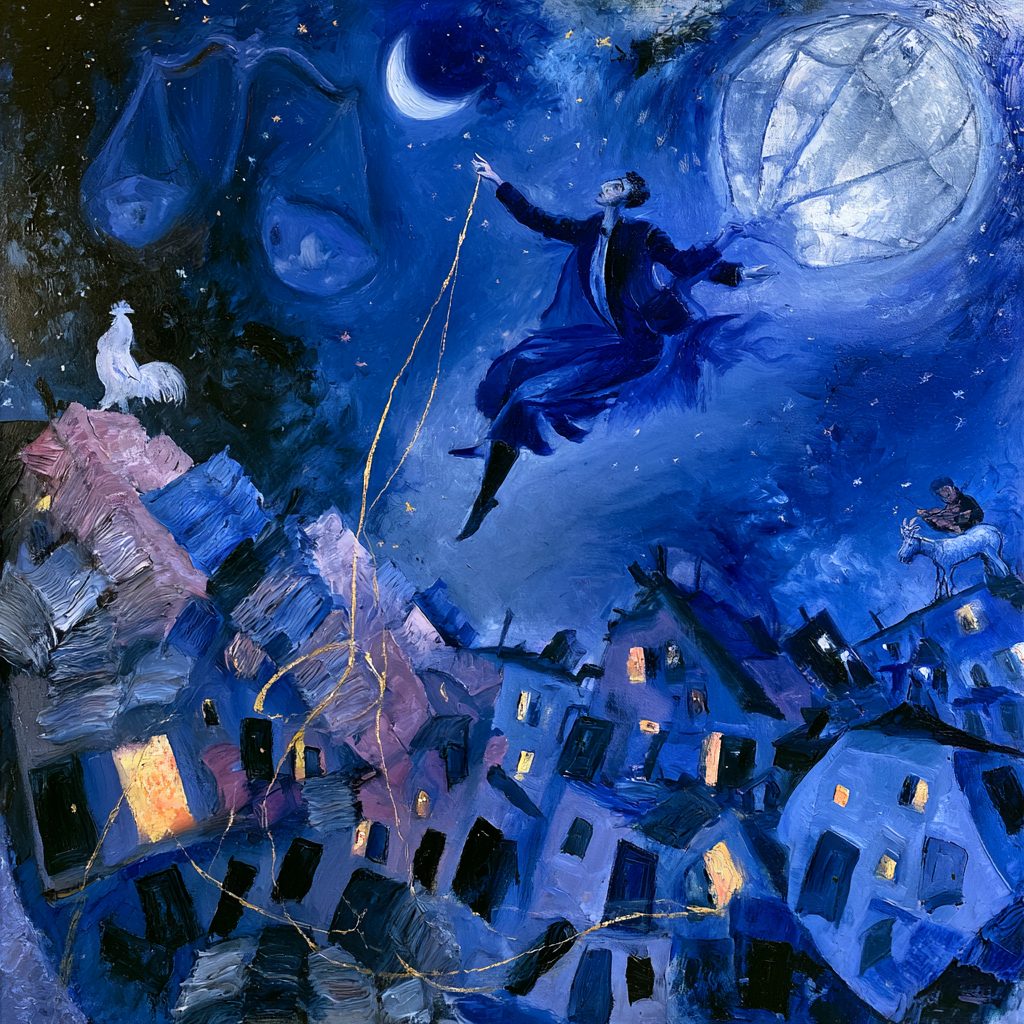
At the second bell of a Gibsonian morning, before the corridor lamps had warmed from blue to amber, Interpreter Sela Marrow let herself into the Interpretive Chamber and set a cup of root tea on the long stone table.
The Chamber was cold at that hour. The air recyclers breathed somewhere behind the walls, a low, patient sound, and the condensers left a smell of wet stone that never quite went away. Through the one high window she could see the lesser moon, small and white, hanging where it always hung. Somewhere on its far side a relay tower was blinking again, as it had not blinked for most of a year.
She sat down and opened the file, although she knew it by heart.
Two names were written on the cover. The first was Mara Tell, sixty-one, relay engineer. The second was the Pell household: two adults, and a daughter born nine days ago.
The file
None of this is real. Gibsonia is an imaginary planet in the Guitaria system, invented by Ross Brodskiy so that a question could be asked in clean air: what method of reading law would a people choose if they had to choose it before anyone held power? The Chamber, the Charter, the engineer and the family are all made up for this story. Only the canons are borrowed from his text, and they are the part that matters.
The facts were simple, and that was the trouble with them.
A little more than four cycles earlier, the Works Office had sent Mara Tell to the lesser moon to repair the signal relay. The tether that should have carried her back failed a week after she arrived. She spent the next four cycles keeping the relay alive and herself with it, until a supply run could reach her. When she came home, she found her rooms occupied. Her tools had been packed into a crate and left by the door.
The settlement's Register had acted under Article 14 of the Settlement Charter:
A dwelling whose resident has been absent from the settlement for more than three cycles shall pass to the next household on the Register.
The next household on the Register was the Pells. They had moved in and painted one wall the color of the terraces, and in time their daughter was born in the back room.
Mara Tell had asked the Chamber to declare that her dwelling never passed. The Pells had asked the Chamber to declare that it did. Both of them, Sela thought, had done nothing wrong at all.
The arguments
The Register's advocate had been good, and brief. Absent is an ordinary word, he had said, and it bears its ordinary meaning at enactment. Mara Tell was not here. And the drafters knew how to excuse an absence when they wanted to. Article 22, on the Council, says a member absent from three sittings shall yield the seat "unless the absence was ordered by the Council." If ordered absences were already excluded from the word absent, that clause would do no work, and the canons forbid reading any text as decoration. Article 14 has no such clause. The drafters could have written one. They did not.
Mara Tell's advocate had argued purpose. Article 14, she said, was written to reclaim abandoned rooms, not to punish a woman for keeping the settlement's voice alive. Everyone in the Chamber had felt the force of that. Everyone in the Chamber also knew the twentieth canon: stated goals and drafters' intentions cannot override clear textual wording. Purpose illuminates ambiguity. It does not rewrite clarity.
Sela had gone home that night and not slept.
The canon she could not use
It was nearly the third bell when she allowed herself to think the thought she had been circling for days.
This is absurd.
A woman is sent by the settlement to mend the settlement's own relay. The settlement's tether fails. And for this, the settlement takes her home. If any result deserved the word, surely this one did. The last of the twenty-three canons existed for exactly this feeling, did it not? Absurditas Vitanda. Absurdity to be avoided.
She read it again, slowly, the way she had been trained to read it.
Where the literal application of clear text would produce a result that is logically impossible, self-contradictory within the instrument itself, or physically or mathematically absurd, the interpreter may apply the nearest non-absurd reading. And then the sentence that closed the door: the canon does not authorize departure from text on grounds of unwise policy, undesirable consequences, or moral discomfort. It is a safety valve for drafting error, not a gateway for judicial preference.
Nothing about Mara Tell's loss was impossible. Nothing in it contradicted itself. It was only cruel, and cruelty was not on the list. The founders had seen her coming, Sela thought, or someone very like her. They had known that one morning an interpreter would sit alone with a file and a cold cup of tea and want, more than anything, to be free. And they had decided, long before there was a Chamber or an interpreter or a Mara Tell, that she would not be.
Anyone who has ever had to decide something for other people knows this hour. The file is closed, and the decision is not. You can feel the outcome you want sitting in your chest like a stone, and you can feel the reasons you would need, and you can feel the distance between them. It is the loneliest distance in the law.
Sela did what the canons told her to do instead. She stopped looking at Article 14 and started reading the Charter from the beginning.
The whole text
The third canon is short. Meaning is derived from surrounding provisions and the instrument as a whole. No provision is read in isolation. Fragments do not govern wholes.
She had read Article 1 a hundred times. Everyone had. It was the article children recited:
The settlement comprises the habitats, the terraces, and every work the settlement maintains.
She read it again, and then she sat very still.
The relay on the lesser moon was a work the settlement maintained. It was, in fact, the work the settlement had sent Mara Tell to maintain. On the Charter's own terms, she had never been absent from the settlement at all. She had been in it, at the far edge of it, holding it together.
It was not a trick, and Sela tested it as if it might be. The fifth canon says a term used in several provisions of the same instrument bears the same meaning throughout, unless the text or a clear structural necessity says otherwise. "The settlement" in Article 14 was the settlement of Article 1. The sixth canon says what the text states prevails over what it is thought to suggest; the everyday sense of "the settlement" as the habitats and nothing more was a suggestion, and Article 1 was a statement. And the Register's best argument, the one about Article 22, still had its full weight, but it pointed somewhere else. A Council member working on the relay would still miss the Council's sittings. Article 22 was about absence from a room. Article 14 was about absence from the settlement. Both clauses kept their work.
She wrote until the lamps turned amber. She wrote down the reading the Register had urged and why it failed. She wrote down the purpose argument and why she had not relied on it, even though it pointed the same way, because she had not needed it and was not permitted to lean on it. She wrote down that the absurdity canon was not available, and why, so that no one reading the decision later would think she had reached for it.
And then she wrote the paragraph that was hardest, the one about the Pells.
What the Chamber could not do
The Chamber could say what the Charter meant. It could not build a room.
The Pells had received the dwelling because the Register had read Article 14 without Article 1. They had done nothing but accept what they were given. Article 5 of the Charter says every resident shall have a dwelling, and that promise ran to the Pells and their nine-day-old daughter as surely as it ran to Mara Tell. But the reading of Article 14 was not the place to keep it. Where the Pells would live was a question for the Council and the Register, the bodies the Charter had empowered to allocate. The canons had been written before anyone knew who would hold that power, and they did not give it to the Chamber.
So she wrote that, plainly: that the Pells' own right under Article 5 was untouched by this decision; that the dwelling had not passed; and that the duty to house the Pells now rested where the Charter placed it. She did not pretend that this was a happy ending. It was only a correct one.
It occurred to her, as she wrote, how close she had come to the other decision. If Article 1 had said less, if it had listed only the habitats and the terraces, then the text would have been clear, and clear against Mara Tell. Sela would have had to write that opinion instead. It would have been right. It would also have been terrible, and she would have said so, and she would have said where the remedy lay: not in her Chamber, but in the amendment of the Charter by the people who make it. Changing times, the fifteenth canon says, are not a license for changing meanings. That sentence cuts in both directions, and on some mornings it cuts the interpreter.
This, she thought, is what the founders meant by method before power. Not that the method is kind. It isn't always. That the method is known. Mara Tell knew, before she ever stepped onto the tether, how her Charter would be read. So did the Pells. So did the Register. None of them had to wonder which theory of reading Interpreter Marrow would favor that morning, or whether she had slept, or which of them she found easier to pity. The canons had taken that power from her long before she took the office. On the hard mornings it felt like a cage. By noon, more often than not, it felt like a floor.
The drawer
The Chamber sat as three that season. One colleague joined Sela's decision. The third, Interpreter Oren Vale, wrote a careful dissent. He argued that in the ordinary speech of the founding years, to be "absent from the settlement" meant to be away from the habitats, whatever Article 1 said about works, and that the drafters of Article 14 had been speaking to residents, not to surveyors. He wrote it in good faith, and he wrote it well.
Under the nineteenth canon, it would not be thrown away. Reasoned dissents are preserved in the permanent interpretive record, and no interpretive tradition is extinguished by disuse or by the dominance of a contrary reading. Vale's dissent would carry no force of its own. It could return only if some future Chamber found this morning's reading manifestly wrong under the canons and could deal fairly with everyone who had relied on it. But it would be there. The Chamber kept a long drawer for such things, and nothing in it was ever discarded.
Sela signed the decision a little after the fourth bell and carried it down the corridor herself.
When she came back, the tea was cold, and the lamps were fully amber, and the lesser moon had moved a little way across the high window. Somewhere on its far side the relay was still blinking, keeping the settlement's voice alive across the dark.
Outside the Register's office, Mara Tell was sitting on her crate of tools. She stood when she saw the interpreter's robe. Sela did not tell her what the decision said. That was not her office either. She only nodded, the way you nod to someone at the edge of a long road, and went back into the Chamber to open the next file.
Frameworks in this piece
Terms in this piece
Revision history
| 26 Jun 2026 | First published in the Institute library. |
How to cite
Voss, E. (2026, June 26). A Morning in the Chamber: An Interpreter, Two Households, and the Canon She Could Not Use. Computational Law Institute. https://institute.legawrite.ai/articles/gibsonia-a-morning-in-the-chamber
Related pieces


New papers, frameworks and essays. No marketing. Or use RSS.